The Secret of Eyup Sultan Mosque
08 December 2025 - Eyüp Sultan Camii
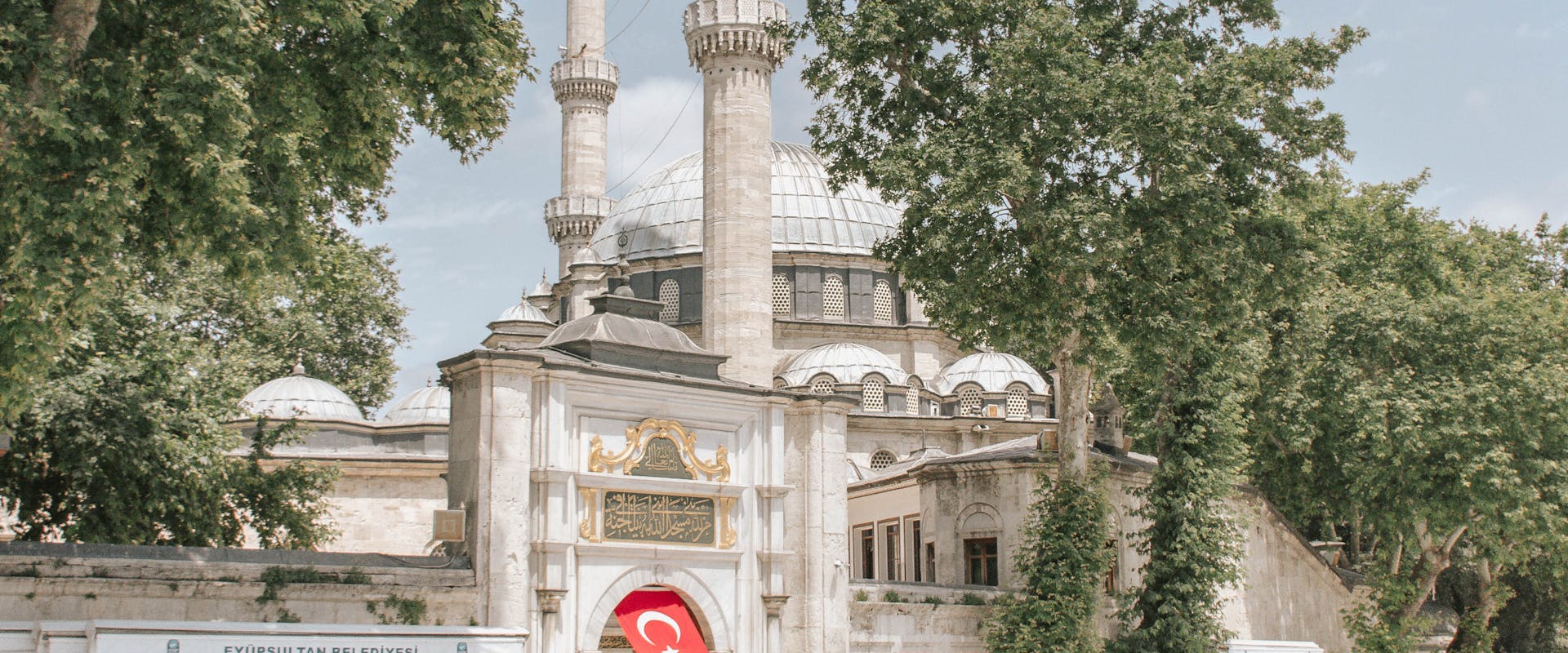
Eyüp Sultan Mosque, as one of the holiest places in Istanbul, has been home to countless secrets throughout the centuries. In this article, we share with you the known and lesser-known secrets of the mosque, its spiritual depth, and the stories hidden in the layers of its history.
\n\nThe Miraculous Discovery of the Lost Tomb
\n\nThe greatest secret of Eyüp Sultan Mosque is undoubtedly the story of how the tomb of Hz. Khalid ibn Zayd Abu Ayyub al-Ansari was discovered. The tomb of this great companion, who passed away during the siege of Constantinople in 669, remained lost for approximately 800 years.
\n\nAccording to tradition, when Fatih Sultan Mehmed conquered Constantinople in 1453, he asked his teacher Akshemseddin to find this tomb. After a long spiritual search and discovery, Akshemseddin identified the location of the tomb. Sources relate that when Akshemseddin pointed to the spot, an excavation at that point revealed a tablet inscribed with 'This is the tomb of Abu Ayyub al-Ansari'.
\n\nThis discovery was a historic event that completed the spiritual dimension of the conquest of Constantinople and reinforced the Ottoman legitimacy in these lands.
\n\nThree Sieges, One City
\n\nThe arrival of Abu Ayyub al-Ansari in Constantinople actually constitutes one of the most fascinating pages of Islamic history. The hadith of the Prophet (peace be upon him): 'Constantinople will surely be conquered. What a wonderful commander is the one who conquers it, and what a wonderful army is that army' kept the Muslim interest in Constantinople alive for centuries.
\n\nAbu Ayyub al-Ansari, despite being over 80 years old, joined the expedition hoping to attain the glad tidings of this hadith. Before falling ill and passing away at the walls of Constantinople, he stated in his will: 'Bury me as close to the enemy territory as possible.' In accordance with this will, his body was buried right at the base of the walls.
\n\nThe Hidden Geometry of the Mosque
\n\nA careful eye can discover many symbolic details in the architecture of Eyüp Sultan Mosque. The main dome of the mosque represents the sky in Islamic cosmology, while the octagonal plan refers to the eight gates of paradise in Islam.
\n\nThe plane tree in the mosque's courtyard has reportedly been standing since the mosque's first construction, and its roots extend close to the tomb. The fountain at the center of the courtyard also symbolizes the eight gates of paradise with its octagonal design.
\n\nIt is known that the most advanced astronomical knowledge of the era was used in calculating the qibla angle that the mihrab faces. Ottoman architects made solar observations and mathematical calculations to determine the qibla direction.
\n\nStories Behind the Walls
\n\nThe calligraphy works on the walls of the mosque were written by different calligraphers over the centuries. Each inscription reflects the artistic understanding of its era and is like a history book carved in stone.
\n\nThe Ayat al-Kursi calligraphy above the mihrab is considered one of the finest examples of Ottoman calligraphic art. According to legend, the calligrapher who wrote this piece, upon completing his work, broke his pen saying 'I can never write anything more beautiful than this'.
\n\nThe tile panels inside the mosque also hold a separate secret. The distinctive blue-white-red patterns of Iznik tiles are not merely decorative; each motif carries symbolic meanings in Islamic art. The tulip represents divine unity, the carnation represents the prophet, and the pomegranate represents the fruit of paradise.
\n\nThe Secret of the Sword-Girding Tradition
\n\nEyüp Sultan Mosque holds great importance as the place where Ottoman sultans girded their swords upon ascending to the throne. This tradition continued from Osman Gazi to the last sultan.
\n\nWhy the sword-girding ceremony was held at Eyüp Sultan has long been debated. Researchers note that performing it in the presence of Abu Ayyub al-Ansari, the host of the Prophet (peace be upon him), provided the sultan with both spiritual power and historical legitimacy.
\n\nDuring the sword-girding ceremony, the sultan would gird the sword of Hz. Omar, placed by the Sheikh al-Islam. This sword was kept in the Sacred Relics section of Topkapi Palace. After the ceremony, the sultan would visit the Eyüp Sultan Tomb and pray.
\n\nThe Source of the Spiritual Atmosphere
\n\nThe vast majority of those who visit Eyüp Sultan Mosque express that they feel an indescribable peace and spiritual atmosphere in the place. Sufis attribute this to the spiritual grace of Abu Ayyub al-Ansari.
\n\nThere is a strong belief among the people that prayers offered during blessed times such as Friday prayer and Laylat al-Qadr at the mosque are accepted. For centuries, people have expressed their most sincere wishes in this sacred place.
\n\nThe Sentinel of the Golden Horn
\n\nThe location of Eyüp Sultan Mosque on the shore of the Golden Horn is not a coincidence. Throughout history, the Golden Horn has been the most strategic point of Istanbul, and Eyüp Sultan has taken on the role of sentinel of this sacred waterway.
\n\nAccording to old legends, the waters of the Golden Horn were considered healing because they flowed in the presence of Eyüp Sultan, and the local people attributed a special meaning to this water. Even today, sitting on the shore of the Golden Horn facing Eyüp Sultan and contemplating is one of the most preferred experiences of visitors.
\n\n\n\n
Eyüp Sultan Mosque is not merely a place of worship; it is a living museum carrying the wisdom, art, and spirituality of centuries, a profound history book, and a source of peace. The best way to discover the secrets of this sacred place is to visit it in person and experience that unique atmosphere.