The Secret of the Banners: Eyup Sultan and the Banner Tradition
06 November 2026 - Eyüp Sultan Camii
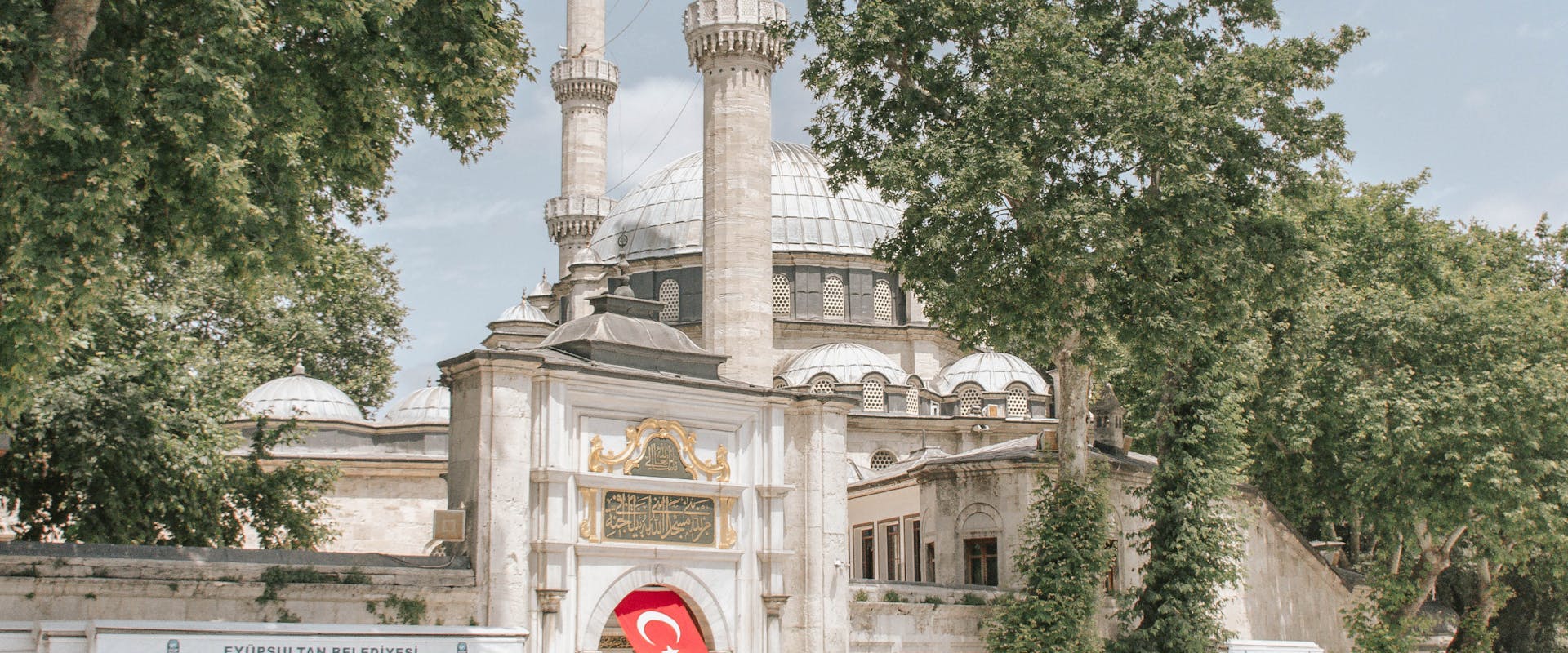
One of the words that comes to mind with Eyup Sultan is the banner. In popular tradition Abu Ayyub al-Ansari is remembered as "the Prophet's standard-bearer", and for centuries Eyup was the spiritual centre where Ottoman sultans girded the sword, a centre of banner and sovereignty. So what does the banner mean in Islam, where does Eyup Sultan's title of "standard-bearer" come from, and where was the most sacred Ottoman banner kept? This article explains the secret of the banners, separating what is documented from what is tradition.
Banner, Liwa, Raya and Alem
Arabic has several words for what we call a banner or flag. In the time of the Prophet the large war banner was called the raya, and the smaller flag marking a unit and its commander the liwa. The hadith sources report that the Prophet's raya was black and his liwa white (al-Tirmidhi, Kitab al-Jihad 9; Ibn Majah, Kitab al-Jihad 20). In Ottoman Turkish the word alem was also used for the banner, and the one who carried it was called the alemdar or sancaktar.
The word "alem" is still part of our lives. When you look at the dome and minarets of Eyup Sultan Mosque, the crescent finial at the very top is also called an alem. So every mosque has a small banner at its summit, visible from afar, announcing "this is a Muslim house of worship". On your next visit, look at the finials of Eyup Sultan's minarets with this in mind.
The Prophet's Banners and Standard-Bearers
In the age of the Prophet the banner was not just a piece of cloth but a symbol of responsibility and loyalty. A banner was not surrendered and not allowed to fall. That is why choosing who would carry it was an important decision for the Prophet:
- Mus'ab ibn Umayr at Uhud: At the Battle of Uhud the banner was carried by Mus'ab ibn Umayr, who was martyred with the banner in his hand (Ibn Hisham, al-Sira). Mus'ab is the Companion whom the Prophet declared the brother of Abu Ayyub al-Ansari after the Hijra. Eyup Sultan's brother in faith was thus one of the most famous standard-bearers in Islamic history.
- Ali at Khaybar: At Khaybar the Prophet said, "Tomorrow I will give this banner to a man who loves Allah and His Messenger and whom Allah and His Messenger love," and gave it to Ali (al-Bukhari, Kitab al-Maghazi 38; Muslim, Kitab Fada'il al-Sahaba 32). Abu Ayyub took part in this campaign and on the way back guarded the Prophet's tent until morning.
- Three standard-bearers at Mu'ta: At the Battle of Mu'ta the banner was carried in turn by Zayd ibn Haritha, Ja'far ibn Abi Talib and Abdullah ibn Rawaha, all three of whom were martyred. Before it could fall, Khalid ibn al-Walid took it up (al-Bukhari, Kitab al-Maghazi 44).
These examples show the real secret of the banner: it was a trust considered more precious than the life of the one who carried it.
Why Is Eyup Sultan Called the "Standard-Bearer"?
In Ottoman tradition and popular usage, Abu Ayyub al-Ansari is called both "the host of the Prophet" and "the standard-bearer of the Prophet". An honest distinction is needed here: the sira and hadith sources describe Abu Ayyub above all as the Companion who hosted the Prophet in his home; there is no clear, well-known record that he carried the Prophet's banner in a particular battle.
The title can be read in the wider sense of the word. Abu Ayyub took part in every campaign of the Prophet from Badr onwards, never stayed behind from campaigns for the rest of his life and, past the age of eighty, carried the banner of Islam as far as the walls of Constantinople. For the people of Istanbul he is the bearer of the first banner of Islam to reach the city. The title expresses reverence for this loyalty. Read his life in Who Was Eyup Sultan?
The Holy Banner: The Most Sacred Ottoman Banner
The most sacred banner of the Ottomans was the Sancak-i Sharif, the Holy Banner believed to have belonged to the Prophet. According to the common account it was brought from Damascus to Istanbul at the end of the 16th century and kept among the Sacred Relics in the Chamber of the Holy Mantle at Topkapi Palace. It was brought out with ceremony only for the most important campaigns and on extraordinary days, when the sultan or grand vizier received it and set out with the army. It is known to have been brought out for the last time in 1914, at the start of the First World War.
A common confusion is worth correcting: the Holy Banner was kept not at Eyup Sultan but at Topkapi Palace, where it remains among the Sacred Relics today. Eyup Sultan's place in the banner tradition is a different one.
Banner and Sword at Eyup
Eyup Sultan's place in Ottoman history is linked not with the banner but with the sword. After their accession, Ottoman sultans came to Eyup Sultan to gird the sword, which meant beginning their reign in the presence of a Companion who had hosted the Prophet. The ceremony ended in 1918 with the sword girding of Sultan Mehmed VI Vahideddin. See our article on the Sword Girding Ceremony.
The sword-girding procession reached Eyup by the Golden Horn or by land, accompanied by the palace banners and band. Eyup, then, was not where the banners were kept, but where the processions marching under them arrived. Many history books also relate that sultans visited Eyup Sultan to pray before important campaigns.
Traces of the Banner in Eyup Today
- The finials of the minarets: The alems on the dome and minarets of Eyup Sultan Mosque are the living counterpart of the word for banner.
- Seeing off soldiers: Young men leaving for military service visiting Eyup Sultan with their families continue the bond between Eyup and love of the banner and homeland.
- Standard-bearers and pashas in the graveyards: Many statesmen and soldiers who carried banners in the Ottoman army rest in Eyup's historic cemeteries. See the Graveyards of Eyup Sultan.
- The memory of the conquest: The banner raised on the walls in 1453 fulfilled the hope Eyup Sultan had carried eight centuries earlier. See Eyup Sultan and the Conquest of Istanbul.
The Real Secret of the Banner
The secret of the banner lies not in its cloth but in the loyalty of the one who carries it. Mus'ab ibn Umayr did not let go of it; the standard-bearers of Mu'ta did not let it fall; and Abu Ayyub al-Ansari carried his whole life like a banner: he opened his door to the Prophet and never left his path afterwards. Everyone who visits Eyup Sultan is, in truth, visiting the memory of this loyalty.
For Eyup Sultan's other secrets, past and present, read The Secret of Eyup Sultan Mosque, and for your visit see our tomb visiting guide.